Marketing tactics for indie devs who built something players will love—and need them to find it. Store pages, community building, launch strategy. Practical approaches that move wishlists without the burnout or identity crisis. For devs ready for specific next steps, not just "make a good game" advice.
Why 73% of NSW Game Devs Are Planning Their Exit: The $150K survey data that's shocking the Australian indie scene
|
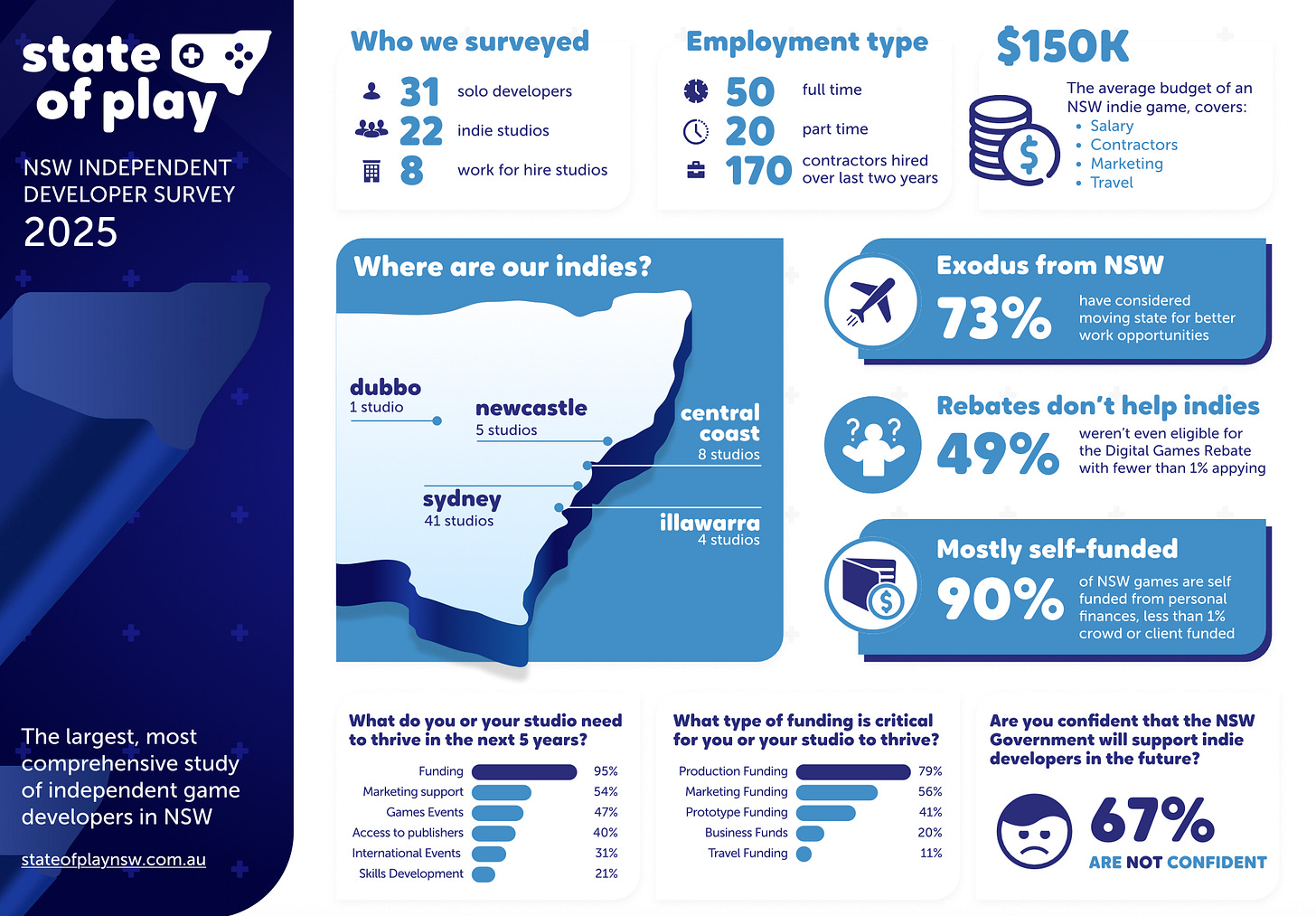 |
The NSW Independent Developer Survey just dropped the most brutal numbers I've seen in years:
NSW indie studios need on average $150,000 to complete a game.
Most are working thousands of unpaid hours to fund their dreams.
And 73.7% are planning to leave the state.
This isn't just a funding crisis—it's a creative exodus.
But here's what the raw survey data doesn't tell you: where every dollar of that $150K should actually go.
After analysing the State of Play findings alongside global market data, I've uncovered why traditional marketing advice (spend 25-50% on promotion) completely fails NSW developers.
The reality? Marketing typically costs $50,000 alone—one-third of your entire budget before you've written a line of code.
Here's the framework that actually works for NSW constraints:
The 30-15-5 Rule:
- 30% Pre-Launch (18 months): $45K for community building
- 15% Launch Window (3 months): $22K for concentrated push
- 5% Post-Launch: $8K for ongoing support
Plus the "Bootstrap Alternative" for studios without $75K marketing budgets.
The complete breakdown includes:
✓ Exact monthly budget allocations ($2,500 pre-launch vs $7,300 launch window)
✓ Platform-specific strategies (Steam vs Mobile approaches for NSW developers)
✓ Geographic reality checks (30% of NSW studios operate outside Sydney Metro)
✓ Bootstrap alternative ($15K cash + sweat equity framework)
✓ Success metrics that matter for cash-strapped studios
✓ Action plan you can implement tomorrow
The Indie Game Dev Compendium
Marketing tactics for indie devs who built something players will love—and need them to find it. Store pages, community building, launch strategy. Practical approaches that move wishlists without the burnout or identity crisis. For devs ready for specific next steps, not just "make a good game" advice.
Hundreds of indie developers have the same three delusions. They spend years building games nobody wants, then blame everything except their own choices. They post in Discord channels asking why their “masterpiece” sold twelve copies while convinced the market just doesn’t understand real artistry. My advice for indie game devs? Don’t go on a Twitter meltdown, telling players to code their own engine or tell unhappy players to get a refund from Steam if they weren’t happy—while your game sat...
Today I'm excited to share my interview with figyberries, solo developer of Pokemon Echo.I reached out during the demo launch last week to talk about what drives hundreds of unpaid development hours, legal risks and how modern tools are reshaping indie creation. Lets dig in! Pokemon Echo Main Menu Page, Source: Figgyberries Nintendo now owns the legal right to summon creatures in video games—despite this mechanic existing since the 1980s. Yet thousands of Pokemon fans continue building...
I don't know about you, but I've played every official Pokemon release since Red. Nostalgia factor aside, my most memorable experiences still comes from fan-created games Games like Pokemon Uranium, Reborn, and Insurgence consistently outperform official releases—with zero budget or marketing. While innovating the design of the franchise a 200+ person team at Gamefreak keeps making worse. Apparently these bedroom coders understand something the official studio has lost. Here's the brutal...